by Karen Largman
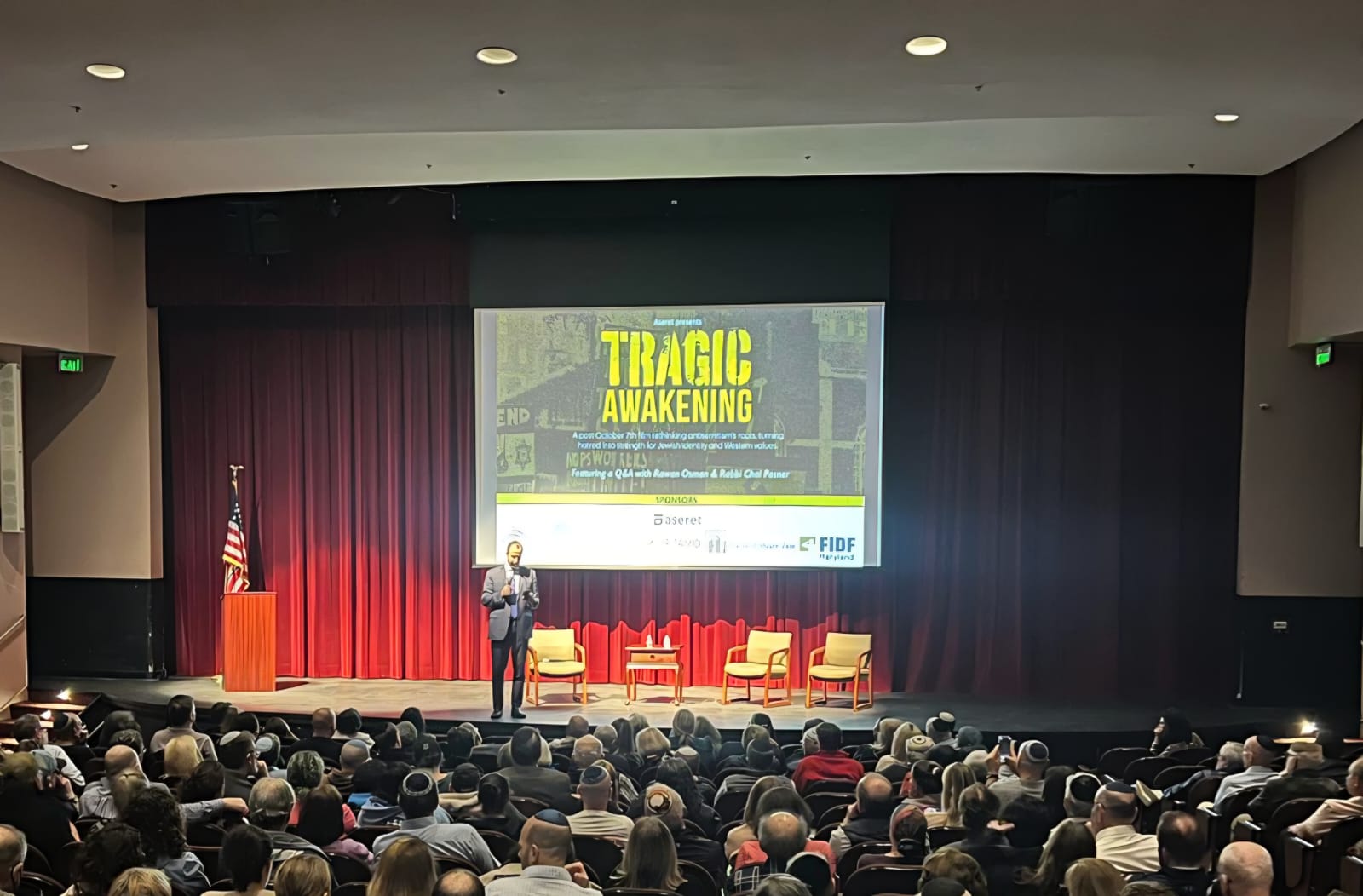
On Thursday, April 3rd, the Beth Tfiloh Mintzes Theater was filled with a captivated audience for the screening of Aseret’s new documentary, Tragic Awakening. The film explores antisemitism’s roots through the story of a Syrian/Lebanese woman. Rawan Osman, who was raised in a Hezbollah stronghold in Lebanon, portrays the harsh realities she experienced under Hezbollah’s rule.
After experiencing Israel for herself, Osman’s eyes were opened to a different reality, and she has since become a strong advocate for Israel and the Jewish people. The event was co-sponsored by Beth Tfiloh and the Baltimore Zionist District, together with community sponsors Shomrei Emunah, Ner Tamid, Bnai Jacob Shaarei Zion, and FIDF Maryland.
Rabbi Nitzan Bergman, Director of Aseret Global, the diaspora division of the Aseret movement, which produced the film in partnership with Raphael Shore, opened the evening. He explained that the Aseret movement is devoted to realigning the Jewish people with our mission and purpose based on the covenantal principles of the Ten Commandments.
Joking that he would not speak for as long as Senator Corey Booker, he said that as a Jew, he feels his message and the message of the evening were just as important. He said,
“A significant change happened in Jewish history on Simchat Torah 5784, Oct 7, 2023. About fifteen years ago, I was driving on a Sunday to shul for mincha with my son Yaacov. We arrived at the four-way stop, on the corner of Labyrinth and Fallstaff, at pretty much the same time as another car from another direction. I decided to go first. The driver in the other car was not happy; he chased closely behind us, and when I pulled in to park next to the shul, he pulled up beside us, rolled down his window, and said, “Hitler should have finished the job.” As shocking as it was, he was an outlier; neither I nor my son had ever experienced something like it. We wrote him off as crazy. We can’t do that anymore.
Rabbi Bergman continued,
“Antisemitism forces us to confront a lot of issues. Our safety? Our future? How to debunk and reeducate antisemites? These are all important issues, but they are not why I am here, and they are not why we made the film. I am here because, as the object of hate, we are forced to ask a very self-effacing question: Who are we? What is it about us that they hate? The answer the film is going to provide is profound. It’s daunting. And most surprisingly, it’s actually inspiring.”
After the screening, Rabbi Bergman offered more reflections:
“We are good. We are the people of light. It’s very simple: Light and darkness, good and evil, are constantly before us. Our purpose, humanity’s purpose, is to make the world a place of light, a place of good, and rid it of darkness and evil. The Jewish mission is to lead this effort. The Oct 7 wake-up call is that we can do better, no, we can be great. Antisemites hate Jews because of our mission. Some antisemites don’t want a better world; they love darkness; these are the sociopaths and psychopaths of our world. The people who can’t tell between heaven and hell. Some people hate us because our very presence reminds them of what they are unwilling to face. Unwilling to take responsibility for themselves, they project their frustration back onto us. Then there are those who hate us because they hate our G-d. They resist the idea of Divine authority and the truths we represent. They want to rule the world.
The war we are in is on all fronts, and it has to be fought on all fronts. The front we are all fighting on, 24/7, is the front of light and darkness. This is, perhaps, the most important battle. Simply put – this is a battle over Sinai – they don’t want it and we need to uphold it.”
He concluded by referencing his book Shining Our Light 10XStronger: The Jewish Mission and explaining the importance of returning to our foundations and viewing our role through the lens of the Ten Commandments.
“Sometimes it feels like a mountain over our heads. No one said it would be easy. But it’s meaningful. It’s the ultimate meaning. It’s the light that will eventually win over their darkness.”
The evening continued with a Q&A with Rawan Osman, whose personal journey adds depth to the film’s themes. She shared her insights on the powerful messages within Tragic Awakening. Her unique background and experiences provided a vital perspective, enriching the following discussion. Rabbi Chai Posner further guided the conversation, helping attendees unpack the film’s significance in today’s world. Audience members were then allowed to ask questions and express their reactions to the film’s emotional and intellectual impact.
The event was a resounding success. For many, it was the first time they had learned about anti-Semitism in this way. When asked how the film was, Mrs. Sharon Benus, mother of Beth Tfiloh’s chair elect, Avi, responded that she was apprehensive coming to the film, but she’s actually leaving inspired.
Aseret plans on organizing many more screenings and follow-up discussions around antisemitism and the Jewish mission for the community.